Showing posts with label Automotive. Show all posts

Garmin taps QNX technology to create K2 infotainment platform

Complete digital cockpit delivers navigation, diagnostics, streaming media, smartphone integration, and voice recognition

Most people are familiar with Garmin's many portable GPS devices, from sports watches to action cameras to PNDs. But Garmin has also created the K2, a next-generation infotainment solution that's built for automakers and based on the QNX CAR platform.

The K2 is a complete “digital cockpit” that comprises multiple digital displays, on- and off-board voice recognition, smartphone integration, and optional embedded 4G connectivity. It's designed to give drivers simple, intuitive access to navigation, vehicle diagnostics, streaming media, and realtime Web information. It's also designed with scalability in mind, so automakers can use it to address diverse market requirements and cost targets.

According to Matt Munn, managing director of Garmin’s automotive OEM group, “the QNX CAR platform has played a major role in helping us to achieve our goal of providing both world-class software reliability and flexible access to emerging consumer applications. From the proven stability and performance of the QNX architecture to the company’s worldwide industry recognition, QNX was the logical choice.”

Other key features of the K2 include a 3D-enhanced city model, a predictive services calendar, and remote personalization and control via a web portal or smartphone.

Here's the K2 at a glance:

Source: Garmin

And here's a demo of the system, filmed by Engadget at 2013 CES:


For more information on this announcement, read the press release. And for more on the K2 itself, visit the Garmin blog.

A version of this article was originally posted on the QNX auto blog.

Panasonic goes global with QNX CAR platform

In the automotive market — or any market, for that matter — a product platform must be judged by its flexibility. After all, the whole point of a platform is to help you create multiple products or product lines, each with its own distinguishing features, while reusing as many components as possible. Done right, a platform lets you target multiple price points, multiple consumer segments, and multiple geographies, in the least time and at the least cost. If that doesn’t define flexibility, I don’t know what does.

Which brings me to Panasonic Automotive Systems Company of America. They’re an international supplier of infotainment systems — Chevy MyLink and Chrysler Uconnect are just two of their products — and they need this kind of flexibility to deliver localized solutions  to their OEM customers in North America, Europe, and Japan. To help achieve it, they use the QNX CAR platform.

Flexible by design: MyLink supports
a touchscreen, voice commands,
and steering-wheel buttons.
To quote Scott Kirchner, vice president and CTO of Panasonic Automotive Systems, “we wanted a platform that would let us quickly customize our infotainment systems for a variety of markets and customer requirements — the QNX CAR platform, with its modular architecture and support for mobile connectivity standards, provides the inherent flexibility we were looking for.”

That quote comes from a press release issued just a few minutes ago. To read the release in its entirety, visit the QNX website. But before you click, remember also to visit the Chevy website, where you can find out more about the MyLink system. And did I mention? MyLink has been building quite the trophy case, what with the Best of CES 2013 Award it won in January and the CTIA Emerging Technology (E-Tech) Award it won in May.

Chevy MyLink system.
Images: Chevrolet

This post originally appeared on the QNX auto blog

Five QNX videos more people ought to see

Looking for examples of how people use QNX? You've come to the right place. From outer space to the automotive space, these five videos demonstrate the sheer flexibility and dynamic range of QNX technology. Better yet, you get to hear five users describe, in their own words, why QNX is important to what they do.

QNX in space
First up is Iain Christie of Neptec, the company responsible for creating the SVS and LCS camera systems on the NASA space shuttle. Highlight: when Ian explains the importance of QNX to the shuttle program (1:46). For more on the QNX-based LCS system, see my previous post.


QNX in the clinic
Next up is Vladimir Derenchuk of the Indiana University Health Proton Therapy Center, which uses proton beams to blast difficult-to-treat tumors. Highlight: it's all good, but listen to Vladimir explain why they chose QNX, and how it has helped with FDA approvals (1:34).


QNX in the HVAC
Next up is Hans Symanczik of Kieback & Peter, a German firm that has used QNX in building automation systems for more than 20 years. Highlight: when Hans explains the ultimate benefit of the QNX OS (2:07).


QNX on the air
Next up is Mikael Vest of NTP, a Danish company that supplies QNX-based audio routers to the global television and radio broadcasting industry. Highlight: Mikael himself, who gladly did this interview despite suffering from a flu to end all flus. A real trooper.


QNX on the road
Next up is Rick Kreifeldt of Harman International, a company known in the automotive industry for its ability to push the technology envelope. Highlight: the section where Rick's respect for the QNX team shines through (2:14).


QNX in flight
And last but not least is Thomas Allen from Mechtronix, a company that has developed an innovative, software-based approach to building flight simulators. Highlight: when Allen states that Mechtronix simulators effectively use the same software architecture as the QNX OS (0:45). Years, ago, someone explained to me how the QNX OS isn't simply a well-designed, modular OS; it also encourages well-designed, modular systems. In Mechtronix, we have an example.


What are the 5 all-time most popular QNX videos?

Geez, I thought you'd never ask. Seriously, the question came to mind earlier this week, so I decided to find out. A quick trip to the QNX YouTube channel provided the answer.

What that trip didn't tell me is why these videos are the most popular. I can think of several reasons, but the most obvious is that the videos all hint at a future in which driving is more connected, more convenient, more enjoyable — and also a little safer. But don't take my word for it. Check out the videos, if you haven't already, and judge for yourself.

Without further ado, here are the top five, along with my favorite scene from each one.

#1
First up, at more than 525,000 views, is Imagined: Your car in the not-so-distant future. Best part: the augmented reality-enhanced stop sign (1:10).


#2
Next, at more than 230,000 views, is QNX seamless connectivity. Best part: John Wall speaking on the real challenge of making a connected car (:50).


#3
Close behind #2, at more than 213,000 views, is The QNX secret to making hands-free noise-free. Best part: The marching band (1:21).


#4
Next, at more than 85,000 views, is QNX HTML5 series - Interview with Pandora's Tom Conrad. Best part: It's all good, but I love the bloopers (3:00).


#5
And last, at more than 34,000 views, is QNX technology concept car - Bentley Continental. Best part: the couches.


One that didn't make it...
And, finally, here's my current favorite. It's not one of the top five... yet. But I think it should be:


What has the QNX auto team been up to?

Well, let's see...


Space-grade technology... in the palm of your hand

What does your phone have in common with planes, trains, automobiles, and space stations? If it's a BlackBerry 10 smartphone, plenty.

When you pick up a BlackBerry Z10 or BlackBerry Q10 phone, you are tapping into OS technology like no other. Technology that hospitals use to defeat cancer. Technology that power plants use to create energy. Technology that skyscrapers use to save energy. Technology that movie studios use to create mind-blowing special effects. And technology that calls for help if your car gets into an accident. In short, technology that makes a difference in my life, your life, everyone's life.

But enough from me. Especially when the video says it so much better...


Successful beyond imagining

Hey, do you remember the "Imagined" video that QNX released back in November? You know, the one that takes a sneak peak at what cars might be like a few years from now? Well, I have a couple of updates.

First, the video has logged more than 518,000 views. Impressive, that. Second, it's
been named an honoree in the annual Webby Awards. Which puts it in the same company as videos from Disney, HBO, and Coca-Cola. Doubly impressive, that!

If you aren't familiar with the Webby Awards, they've been dubbed by the New York Times as the “Internet’s highest honor.” You can find out more about them here. And while you're at it, check out the blog post from Mike Edgell, the creative director at Thornley Fallis, the company that helped us realize our vision of tomorrow's car.

The winners of the Webby Award winners will be announced tomorrow, April 30. Just one more day...


What has the QNX auto team been up to?

Well, let's see...


Why does all the cool stuff happen while I'm away?

Now appearing in both 
Fortune and Daily Planet
Do you ever get the feeling that the party starts the minute you leave the room? Well, it just happened to me. I was on vacation only a few days last week, but while I was away, Fortune magazine and Daily Planet both did pieces on QNX. What's up with that?

But seriously, this is cool. The Fortune article covers several bases: the history of QNX in mission-critical embedded systems, the leadership that QNX enjoys in automotive, and the new QNX concept car that made its debut at 2013 CES. Meanwhile, the Daily Planet video puts you in the front seat of the concept car for a tour of its many features — from voice control and video conferencing to the virtual mechanic. (Is it just me, or do the coolest features all start with the letter 'v'?)

Read the Fortune article here (you'll need a subscription to access it). And view the Daily Planet video here.

The isolation imperative: protecting software components in an ISO 26262 system

Software components can be impolite, if not downright delinquent. For instance, a component might:

  • rob other components of CPU time
  • rob other components of file descriptors and other system resources
  • access the private memory of other components
  • corrupt data shared with other components
  • create a deadlock or livelock situation with other components

Shameful, I know. But in all seriousness, this sort of behavior can wreak havoc in a safety-critical system. For instance, let's say that a component starts to perform a CPU-intensive calculation just as the system enters a failure condition. Will that component hog the CPU and prevent an alarm process from running?

The answer, of course, is that it damn well better not.

It becomes important, then, to prevent components from interfering with one another. In fact, this principle is baked into the ISO 26262 functional safety standard for road vehicles, which defines interference as:

    "...the presence of cascading failures from a sub-element with no ASIL [Automotive Safety Integrity Level] assigned, or a lower ASIL assigned, to a sub-element with a higher ASIL assigned leading to the violation of a safety requirement of the element”

To put it crudely, less important stuff can't stop more important stuff from happening.

So how do you prevent interference? One approach is through isolation. For instance, a system may implement spatial isolation between application processes. This would include mechanisms for interprocess communication and interprocess locking that prevent one process from inadvertently affecting another.

Mind you, there are multiple types of interference, so you need to implement multiple forms, or axes, of isolation. Time for a picture:


In general, you need to determine what does, and what doesn't, need to be isolated. You also need to identify which components are apt to be delinquent and build a cage around them to protect more critical components. Which brings me to a recent paper by my inestimable colleagues Chris Hobbs and Yi Zheng. It's titled "Protecting Software Components from Interference in an ISO 26262 System," and it explores techniques that can help you:

  • implement the component isolation required by ISO 26262
  • demonstrate that such isolation has been implemented

And while you're at it, check out the other titles in our "safe" whitepaper series. These include "The Dangers of Over-Engineering a Safe System" and "Ten Truths about Building Safe Embedded Software Systems."

And don't worry: there's nothing delinquent about downloading all of them.

This post originally appeared in the QNX auto blog.

All roads lead to QNX at embedded world 2013

Montreal, my home town, was once known as a city of churches. So much so that Mark Twain famously quipped, "this is the first time I was ever in a city where you couldn't throw a brick without breaking a church window."

If Mr. Twain were alive today and able to visit embedded world 2013, he might make a similar comment about QNX. Because it seems that, wherever you turn at embedded world, someone is demonstrating a QNX-based system.

Multimedia and wireless demos
First stop is the QNX booth, where you'll find a natty new demo designed to showcase our support for wireless, video, and HMI technologies. Among other things, the demo shows how QNX lets you work with a mix of application and graphics environments, including Qt 5.0, OpenGL ES 2.0, and Crank Software’s Storyboard Suite.

Power up the demo, and you'll see several applications, including a medical monitor:


and a speedometer:


You'll also find games, a digital thermostat, a photo viewer, an audio meter, and several other demo apps. And did I mention? You can find two of these demo systems in the QNX booth, one based on a Freescale i.MX 6 SABRE Lite board and the other on a TI AM335 Starter Kit board.

PLC demos
If you're a hard-core industrial developer, be sure to catch the two programmable logic controller (PLC) platforms in the QNX booth. These platforms were a group effort: QNX provided the OS; companies like IsaGRAF, KW-Software, and koenig-pa provided the ladder logic and EtherCAT software; and Freescale and TI provided the hardware — one platform is based on a Freescale QorIQ TWR-P1025 Tower System Module, the other on a TI Sitara AM335x ARM Cortex-A8 processor.

The purpose of these platforms is simple: to reduce the time and cost of developing PLCs and other industrial systems. If you're interested, the eval software for the platform based on the Freescale module is now available for download from the QNX website.

QNX CAR platform demo
No, we didn't drive the new QNX concept car to embedded world. But we did bring a demo of the QNX CAR application platform, and from what I hear, it's driving lots of booth traffic (pun fully intended). Here's a snap of the demo, taken on the show floor:


Lotsa partner demos
Take a walk down the aisle, and you'll soon come across several other vendors showing QNX-based systems. Here are the ones we've identified so far:

Acontis is demonstrating its EC-Motion EtherCAT motion library running on the QNX Neutrino RTOS and a TI Sitara AM335x ARM Cortex-A8 processor. Hall 1/1-538.

Crank Software is demonstrating an automotive demo based on the QNX CAR application platform. Hall 4/4-330.

Digia is demonstrating “Qt 5 on the QNX platform – a Cinematic Experience,” which will show many new features in Qt 5 Qt Quick 2. Hall 4/4 – 520.

Freescale and koenig-pa are demonstrating a PLC reference platform that integrates koenig-pa EtherCAT protocol software, ISaGRAF PLC firmware, and the QNX Neutrino RTOS on a Freescale dual-core QorIQ P1025 processor. Hall 4A/4A-206 and Hall 5/5-425.

KDAB is showcasing an IP camera demo written in Qt5 and QML, and running on the QNX Neutrino RTOS and a Freescale i.MX 6 SABRE Lite ARM Cortex-A9 platform. Hall 4/4-622.

KW-Software is demonstrating a PLC development platform developed in collaboration with QNX Software Systems, TI, and koenig-pa. Hall 1/1-446.

MPC Data, a Bsquare Company, is showcasing a high-performance graphics demo based on OpenGL and the QNX Neutrino RTOS. Hall 4A/4A-108.

Xilinx is showcasing a high-precision, low-noise, multi-motor electrical drive demo running on the QNX Neutrino RTOS. Hall 1/1-205.

For more details on these demos, check out the press release that QNX issued this morning.

The joy of talking
Several QNX experts are presenting technical talks at embedded world:
  • Clear SOUP and COTS Software for Safety-Critical Systems — Tues, Feb 26, 14:00 - 14:45, Session 03
  • The Joy of Scheduling — Thurs, Feb 28, 10:00 - 10:30, Session 19
  • Ten Truths about Building Safe Software — Thurs, Feb 28, 14:15 - 15:00, Session 21
  • Issues in M2M Communication for Software and Firmware Updates — Thurs, Feb 28, 16:30 - 17:00, Session 24

So, if for some strange and inexplicable reason, you want to avoid all things QNX, don't go to embedded world this week. Because once you arrive, there will be no escape. :-)

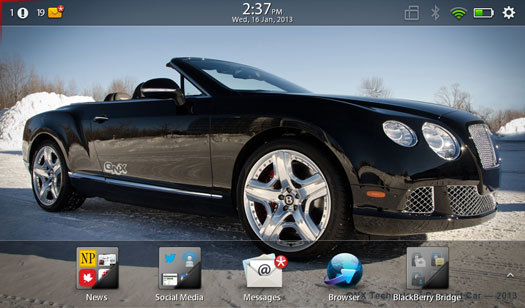
New wallpaper for your BlackBerry PlayBook — QNX concept car 2013

Our good friend (and ace graphics designer) Michael Ball took some excellent photos of the new QNX technology concept car, just before it was shipped to 2013 CES. I thought this photo looked especially cool when displayed on my PlayBook tablet, so I converted it into a wallpaper that you can download from my Flickr page:


To download the wallpaper to your PlayBook:
  1. Go to http://www.flickr.com/photos/paulleroux
  2. Tap the wallpaper.
  3. A larger image will appear. Tap Actions, then tap View all sizes.
  4. An even larger image will appear! Tap Download the Large size of this photo.
  5. Your PlayBook will ask you to enter a file name. Type something meaningful, such as concept_car_wallpaper.jpg, and tap Save.
  6. From the PlayBook home screen, tap Pictures, then tap Downloads.
  7. Tap the wallpaper you want, swipe from the top of the screen and tap Set as Wallpaper.

    You're done!

Using Crank Storyboard to create an automotive user interface

Just how adept is the QNX CAR application platform at supporting a variety of user interface technologies and toolkits?

From the beginning, we've promoted flexibility as a key quality of the QNX CAR application platform. For instance, the platform lets you work with a variety of user interface technologies, including HTML5, Qt, OpenGL ES, and others. What's more, it lets you blend UI components built with different technologies on the same display, at the same time. You're not forced into using a single API or toolkit.

When it came time to build our new technology concept car, we decided to put this flexibility to the test. After all, the whole point of the concept car is to demonstrate the capabilities of the QNX CAR platform. So, for the first time, we tried building a user interface with the Storyboard Suite from Crank Software.

How well did the QNX CAR platform and Storyboard work together? I think the results speak for themselves. For instance:


Of course, this photo can't demonstrate the smooth animations and snappy performance of the car's user interface. For that, I recommend one of the videos shot at CES, including the excellent video from TI.

So why did we choose Storyboard? For one thing, it allowed our concept team to take UI components created in Photoshop and import them directly into their live design. Rather than spend days or weeks recreating the UI in code, the team's engineers were able to start with what the UI designer provided. Which made prototyping and fine-tuning the UI a lot easier.

Mind you, that wasn't the only reason the team used StoryBoard. But instead of listening to me blather about it, check out this video:


Key takeaway: If you're building a UI for your QNX-based system, you owe it to yourself to check out Crank's Storyboard Suite. You can learn more on the Crank website.

QNX at 2013 CES: The media's take

The show ain't over yet, but already, media coverage of the QNX concept car at 2013 CES is pouring in faster than my modest brain can handle. I'm still catching up, but here, in no particular order, are my favorite stories so far.

I'd love to hear what you think of what the media is saying. So before you go, let me know!


Car Design NewsQNX Car 2 at CES 2013 (video)


TechnoBuffalo — Chevy, Ford, and QNX at CES 2013 (video)


That's it for now. I aim to post some more stories and videos early next week. Stay tuned.

This post originally appeared on the QNX auto blog.

QNX-powered Chevy Mylink drives home with Best of CES award

Congratulations to the infotainment team at Chevrolet! Their next-generation Chevy MyLink system has just won a Best of CES award, in the car tech category. The competition judges were particularly impressed with MyLink's user interface and integration with the car's instrument cluster.

The MyLink system was one of two QNX-powered finalists in this year's competition; the other was Garmin's K2 infotainment platform.

Chevy plans to roll out the new version of MyLink later this year.

This post originally appeared on the QNX auto blog.

Two QNX customers, Chevrolet and Garmin, shortlisted for 2013 Best of CES awards

Who doesn't love to win an award? Last year, for example, we were absolutely thrilled that our QNX CAR application platform drove home with a Best of CES award. Heck, I'm still excited!

But here's the thing. All of the products and services that QNX offers are designed with one goal in mind: to make our customers successful. The more our customers succeed, the more QNX succeeds. Which is why I am doubly excited today. Because not one, but two customers have nabbed finalist spots at this year's Best of CES awards for their QNX-based products: Chevrolet for its second-generation MyLink system, and Garmin for its K2 infotainment platform.

Congratulations to our friends at Chevrolet and Garmin — I'll be rooting for all of you!

The winners of this year's Best of CES awards will be announced today, at 11 am PT.

This post originally appeared on the QNX auto blog.

Now on YouTube! First video of QNX technology concept car

Yesterday, some friends from Texas Instruments dropped by our CES booth for a demo of the new QNX concept car. The cameras were rolling, and here's what they caught.

Mark Rigley, head of the QNX concept team, did a fantastic job of guiding TI's Michael Guillory through the car's many features, including the gorgeous HD display powered by TI DLP technology and by a TI OMAP 5 processor. Check it out:


My favorite part? The exceedingly cool video conferencing. What's yours?

This post originally appeared on the QNX auto blog.

QNX unveils brand new concept car (hint: it's a Bentley)

If you haven't visited the QNX auto blog today, you've been missing all the action. This morning, QNX Software Systems took the wraps off a new technology concept car, based on a specially modified — and drop-dead gorgeous — Bentley Continental GT.

Here's an example of what you've been missing:


I've posted many other images on the QNX auto blog, along with guided tour of the car's many features. So what are you waiting for? Check it out.


Self-baking NAND flash memory promises to last longer — way longer

Don't get too excited, as no one is talking commercial availability just yet. But a memory manufacturer has developed a way to make NAND flash last more than 1000 times longer than it does today.

Let's rewind a minute. Each memory "cell" in conventional NAND flash has a limited number of program/erase (PE) cycles. Even a read operation weakens the charge that maintains the data bits. As a result, the NAND cells in your notebook, smartphone, thumb drive, or tablet can often handle only a few thousand PE cycles before they start losing bits. And who wants to lose bits?

Enter Macronix. Using a technique that briefly heats individual cells to 800C (yes, hotter than your kitchen stove), their innovative new NAND flash technology can handle 100 million PE cycles.

I must admit, my first reaction was "so what?". People go through mobile devices like potato chips, so do they really need flash memory that keeps running year after year? But then I thought, what if you're embedding flash in a car that might be on the road for 15 years? Or in an industrial control system that might be deployed once and never replaced? (The QNX OS can be found in industrial systems that have run for 15 or 20 years without a hardware upgrade, so this isn't an academic question.)

There's another reason why this is welcome news. As process size shrinks, so does the usable life of NAND flash. The new technology from Macronix may enable our future devices to offer much more memory, without the downside of a short lifespan.

I'm not an expert on flash memory, so please comment if you have further insight as to how this new technology could benefit future devices.

For more on this development, see the articles on Ars Technica and ExtremeTech.

New video: Your next car, imagined

It blows my mind, but some people still see connectivity in the car as the enemy. They think that, the more connected the car, the more distracting and dangerous it will be. But you know what? Responding to their concerns is easy. I simply ask them what if.

For instance, what if connectivity helped you drive with greater situational awareness? What if it helped you sidestep traffic jams and axle-busting pot holes? What if it helped you detect a stop sign hidden behind a tree? And what if it helped you become more connected to the people important to you, as well as to the road and the cars around you?

When we talk connectivity at QNX, that’s the kind of connectivity we envision. It isn’t just about Bluetooth or Wi-Fi or LTE — that’s only the plumbing. Rather, it’s about keeping you in tune and in sync with your car, your environment, your business, your friends. Your life.


This post originally appeared on the QNX auto blog.