Showing posts with label Connected car. Show all posts

Panasonic goes global with QNX CAR platform

In the automotive market — or any market, for that matter — a product platform must be judged by its flexibility. After all, the whole point of a platform is to help you create multiple products or product lines, each with its own distinguishing features, while reusing as many components as possible. Done right, a platform lets you target multiple price points, multiple consumer segments, and multiple geographies, in the least time and at the least cost. If that doesn’t define flexibility, I don’t know what does.

Which brings me to Panasonic Automotive Systems Company of America. They’re an international supplier of infotainment systems — Chevy MyLink and Chrysler Uconnect are just two of their products — and they need this kind of flexibility to deliver localized solutions  to their OEM customers in North America, Europe, and Japan. To help achieve it, they use the QNX CAR platform.

Flexible by design: MyLink supports
a touchscreen, voice commands,
and steering-wheel buttons.
To quote Scott Kirchner, vice president and CTO of Panasonic Automotive Systems, “we wanted a platform that would let us quickly customize our infotainment systems for a variety of markets and customer requirements — the QNX CAR platform, with its modular architecture and support for mobile connectivity standards, provides the inherent flexibility we were looking for.”

That quote comes from a press release issued just a few minutes ago. To read the release in its entirety, visit the QNX website. But before you click, remember also to visit the Chevy website, where you can find out more about the MyLink system. And did I mention? MyLink has been building quite the trophy case, what with the Best of CES 2013 Award it won in January and the CTIA Emerging Technology (E-Tech) Award it won in May.

Chevy MyLink system.
Images: Chevrolet

This post originally appeared on the QNX auto blog

Successful beyond imagining

Hey, do you remember the "Imagined" video that QNX released back in November? You know, the one that takes a sneak peak at what cars might be like a few years from now? Well, I have a couple of updates.

First, the video has logged more than 518,000 views. Impressive, that. Second, it's
been named an honoree in the annual Webby Awards. Which puts it in the same company as videos from Disney, HBO, and Coca-Cola. Doubly impressive, that!

If you aren't familiar with the Webby Awards, they've been dubbed by the New York Times as the “Internet’s highest honor.” You can find out more about them here. And while you're at it, check out the blog post from Mike Edgell, the creative director at Thornley Fallis, the company that helped us realize our vision of tomorrow's car.

The winners of the Webby Award winners will be announced tomorrow, April 30. Just one more day...


Why does all the cool stuff happen while I'm away?

Now appearing in both 
Fortune and Daily Planet
Do you ever get the feeling that the party starts the minute you leave the room? Well, it just happened to me. I was on vacation only a few days last week, but while I was away, Fortune magazine and Daily Planet both did pieces on QNX. What's up with that?

But seriously, this is cool. The Fortune article covers several bases: the history of QNX in mission-critical embedded systems, the leadership that QNX enjoys in automotive, and the new QNX concept car that made its debut at 2013 CES. Meanwhile, the Daily Planet video puts you in the front seat of the concept car for a tour of its many features — from voice control and video conferencing to the virtual mechanic. (Is it just me, or do the coolest features all start with the letter 'v'?)

Read the Fortune article here (you'll need a subscription to access it). And view the Daily Planet video here.

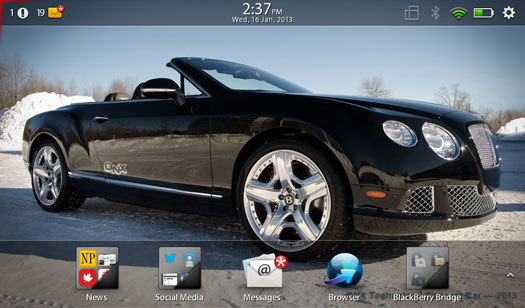
New wallpaper for your BlackBerry PlayBook — QNX concept car 2013

Our good friend (and ace graphics designer) Michael Ball took some excellent photos of the new QNX technology concept car, just before it was shipped to 2013 CES. I thought this photo looked especially cool when displayed on my PlayBook tablet, so I converted it into a wallpaper that you can download from my Flickr page:


To download the wallpaper to your PlayBook:
  1. Go to http://www.flickr.com/photos/paulleroux
  2. Tap the wallpaper.
  3. A larger image will appear. Tap Actions, then tap View all sizes.
  4. An even larger image will appear! Tap Download the Large size of this photo.
  5. Your PlayBook will ask you to enter a file name. Type something meaningful, such as concept_car_wallpaper.jpg, and tap Save.
  6. From the PlayBook home screen, tap Pictures, then tap Downloads.
  7. Tap the wallpaper you want, swipe from the top of the screen and tap Set as Wallpaper.

    You're done!

QNX at 2013 CES: The media's take

The show ain't over yet, but already, media coverage of the QNX concept car at 2013 CES is pouring in faster than my modest brain can handle. I'm still catching up, but here, in no particular order, are my favorite stories so far.

I'd love to hear what you think of what the media is saying. So before you go, let me know!


Car Design News — QNX Car 2 at CES 2013 (video)


TechnoBuffalo — Chevy, Ford, and QNX at CES 2013 (video)


That's it for now. I aim to post some more stories and videos early next week. Stay tuned.

This post originally appeared on the QNX auto blog.

QNX-powered Chevy Mylink drives home with Best of CES award

Congratulations to the infotainment team at Chevrolet! Their next-generation Chevy MyLink system has just won a Best of CES award, in the car tech category. The competition judges were particularly impressed with MyLink's user interface and integration with the car's instrument cluster.

The MyLink system was one of two QNX-powered finalists in this year's competition; the other was Garmin's K2 infotainment platform.

Chevy plans to roll out the new version of MyLink later this year.

This post originally appeared on the QNX auto blog.

Now on YouTube! First video of QNX technology concept car

Yesterday, some friends from Texas Instruments dropped by our CES booth for a demo of the new QNX concept car. The cameras were rolling, and here's what they caught.

Mark Rigley, head of the QNX concept team, did a fantastic job of guiding TI's Michael Guillory through the car's many features, including the gorgeous HD display powered by TI DLP technology and by a TI OMAP 5 processor. Check it out:


My favorite part? The exceedingly cool video conferencing. What's yours?

This post originally appeared on the QNX auto blog.

QNX unveils brand new concept car (hint: it's a Bentley)

If you haven't visited the QNX auto blog today, you've been missing all the action. This morning, QNX Software Systems took the wraps off a new technology concept car, based on a specially modified — and drop-dead gorgeous — Bentley Continental GT.

Here's an example of what you've been missing:


I've posted many other images on the QNX auto blog, along with guided tour of the car's many features. So what are you waiting for? Check it out.


New video: Your next car, imagined

It blows my mind, but some people still see connectivity in the car as the enemy. They think that, the more connected the car, the more distracting and dangerous it will be. But you know what? Responding to their concerns is easy. I simply ask them what if.

For instance, what if connectivity helped you drive with greater situational awareness? What if it helped you sidestep traffic jams and axle-busting pot holes? What if it helped you detect a stop sign hidden behind a tree? And what if it helped you become more connected to the people important to you, as well as to the road and the cars around you?

When we talk connectivity at QNX, that’s the kind of connectivity we envision. It isn’t just about Bluetooth or Wi-Fi or LTE — that’s only the plumbing. Rather, it’s about keeping you in tune and in sync with your car, your environment, your business, your friends. Your life.


This post originally appeared on the QNX auto blog.

Meet the folks behind the QNX concept car (and other cool stuff)

An example of the concept
team's work
Imagine if you went to a Rolling Stones concert and the entire band played behind a curtain. That would be totally weird, right? Well, we realized that much the same scenario was playing out with the QNX concept team. Their work, including the QNX concept car, has appeared in A-list venues like CES and Mobile World Congress, yet the team itself has remained largely behind the curtain. And that’s too bad, since the team members embody the qualities I like best about QNX. Innovation, for example.

So, in the spirit of setting things right, we decided to pull back that curtain and make some introductions. And where better to start than with Mark Rigley, the team’s director.

If I were to describe Mark in one word, I’d choose chutzpah. Or gumption. Or moxie. He is the antithesis of wait-and-see. To spot him in a room, just look for the guy who says, “Let’s do it!” when everyone else is still stuck in “maybe,” “might work,” or “I need to get back to you on that.” And when you think about it, that attitude fits the bill perfectly. Because when your job is to take something like a Porsche 911 (an example of automotive perfection, if ever there was one) and make it even cooler, you’d better have a measure of confidence in yourself — and in your team.

Indeed, if anything shines out from this interview, it is the awe and respect that Mark holds for his team members. (Okay, I’ll admit it. Something else shines brightly: Mark’s enthusiasm for the next QNX technology concept car. Did I mention the team is working on one?)


This post originally appeared on the QNX auto blog.

My connected car word cloud is (still) getting around

Has it been 3 years already? I can't believe it. In any case, this story begins in 2009, when I generated a word cloud to promote the LTE Connected Car, a concept vehicle created by Alcatel-Lucent, QNX Software Systems, Atlantic Records, Toyota Motor Sales, and the ng Connect alliance.

Here's what the word cloud looked like:


Click to magnify.

I created the word cloud just for fun, but thought the result was pretty cool — and it seems I wasn't alone. Someone from BMW, for instance, used the word cloud in a conference presentation back in 2010.

Fast forward to last week, when I discovered that Google has a reverse image lookup function. (Yes, I know, I'm probably one of the last people on the planet to make this discovery.) And so, once again for fun, I decided to see if any images I've published have made their way onto other websites. I thought that the word cloud would be a good candidate, and I was right.

For instance, the word cloud has appeared on these sites (text blurred to respect copyright):

Computer World Brazil:


Social Media Council Europe:


inTELEMATICS today:


UIEvolution blog:


WinfWiki wiki:


There are a few other sites, but frankly, I don't understand what some of them are about. Still, it's cool to know I've created something that fills a need, however miniscule. Mind you, it would be even cooler if everyone who used the image acknowledged where they got it. Just saying.

And speaking of presidents...
This is a near-total non-sequitur, but in honor of the upcoming U.S. election, here are word clouds for every presidential inaugural address, starting with George Washington's address in 1789. (And no, the cloud doesn't contain the words "cherry," "tree," or "lie".)

In-car infotainment and the art of doing more with less

No, not that kind of squeezing.
Granted, the title for this blog post doesn't have the pizazz of, say, "Zen and the Art of Motorcycle Maintenance." (Are you old enough to even remember that book?) But it does capture the gist of a webinar that my colleague Andy Gryc will deliver next week.

His title for the webinar is "Squeezing high-end technologies into low-end infotainment systems." Admittedly, it's more direct than mine. Which is fitting, given that Andy has direct experience designing in-car systems. OnStar, for example.

But I digress. I'm sure you'd like to know what Andy plans to cover, so here's the overview:

    Squeezing high-end technologies into low-end infotainment systems
    Today's infotainment systems have it all – full multimedia, mobile device integration, POI-enabled navigation, speech recognition, high-resolution graphics, and cloud connectivity. The only problem is all of these features come with a big price tag.
    Join Andy Gryc, automotive marketing manager, for this webinar, where he answers the question: Is it possible to build an infotainment system that meets today's customer demands with yesterday's price tag?
    A 50-minute session (plus Q&A), this webinar covers a number of techniques to help slim down your next infotainment's BOM cost; it also suggests ways to target the luxury segment as well as the more cost-conscious, high-volume one with the same basic technology.
    Date: Tuesday October 23, 2012
    Time: 12:00 pm ET
    Duration: 1 hour, including Q&A
    Who should attend: Automotive software engineers and managers

This post also appeared on the QNX Auto Blog.

QNX at SAE Convergence: Cool screens and a mobile theme

Let's start with the theme. And no, I don't mean the kind of theme you download onto your smartphone. I'm referring instead to the main theme of a press release that QNX issued yesterday at SAE Convergence.

First, some context. If you're an automaker, you have little choice: you have to offer infotainment systems that can keep pace with the crazy fast advances in mobile devices. You also need to keep your systems fresh with apps, features, and content that consumers will expect long after they've bought your car. And to do that, you'll need to tap into the skills and products of the mobile app community. Otherwise, that ultra-cool infotainment system you ship today will rapidly transform itself into the 8-track of tomorrow. Goodbye, brand image.

The QNX CAR 2 application platform, with its solid grounding in HTML5, is designed to help infotainment-system designers conquer these (admittedly difficult) challenges. HTML5, after all, has become the lingua franca of the mobile apps market and offers an ideal bridge between the mobile and automotive worlds.

One thing was missing, though — a toolkit that would make it easy for mobile app developers to target the QNX CAR 2 platform. Yesterday, at SAE Convergence, QNX announced a new HTML5 SDK designed to do just that.

An SDK for (auto)mobile developers
The HTML5 SDK for the QNX CAR 2 platform is an extension of the open source BlackBerry WebWorks framework, specially optimized for automotive environments. It allows developers to write, test, and package feature-rich automotive apps based on HTML5, CSS3, JavaScript, and other open standards. It also provides the missing glue between high-level apps and the car, through specialized APIs that provide access to automotive devices and hardware.

Runtime emulator for quicker testing and debugging
This is where the first of the screens comes in. To speed development, the HTML5 SDK provides an emulator that lets developers quickly see how their apps would look and function in a car. Developers can use the emulator to perform JavaScript debugging, HTML DOM inspection, automated testing, and screen-resolution emulation, all from the convenience of a web browser. They can even make changes to their apps and view the results without having to recompile. The simulator is based on the open source BlackBerry Ripple emulator, used by thousands of mobile developers.

For instance, in this screen capture, the emulator is being used to test the virtual mechanic provided by the QNX CAR 2 platform:


Click to magnify

Here's another example, where the emulator is being used to test an audio control application. If you were running this emulator session, you could manipulate the app's onscreen controls to adjust volume, bass, treble, fade, and balance; you could also observe the changes to the underlying data values in the right-hand panel. And you could work the other way: by changing the controls on the right, you could observe changes to the app.


Click to magnify.

QNX also plans to create a virtual marketplace that will allow developers to make their QNX CAR 2 applications available to automakers. The marketplace will provide common ground for app developers and automakers to work together, and will allow automakers to preview the applications that best fit their brands and satisfy their customers. The marketplace is expected to go live when the HTML5 SDK is released.

By the way, my colleague Kerry Johnson provides an interesting back story to the SDK, including the kinds of APIs it provides. You can read his post here. You can also find more images of the emulator on the QNX Flickr page.

3D navigation from Elektrobit
Now for the other screens. Besides announcing the SDK, QNX has brought its QNX reference vehicle, a modded Jeep Wrangler, to the SAE show floor. As always, the Jeep is running the QNX CAR 2 platform. But this time, the Jeep also includes a cool 3D navigation app from automotive software vendor Elektrobit. Here are two examples of the Elektrobit app:


That's it for now. But before you go, be sure to follow @QNX_Auto on Twitter, where we are covering the latest developments, both QNX and non-QNX, from SAE Convergence.

What has the QNX auto team been up to?

Well, let's see...


Green shift: QNX sponsors EcoCar 2 competition

This just in: QNX has officially announced that it is a bronze sponsor of the "EcoCar 2: Plugging in to the Future" competition. Established by GM and the U.S. Department of Energy, the competition challenges universities across North America to reduce the environmental impact of a Chevrolet Malibu without compromising performance, safety, or consumer acceptability.

QNX Software Systems will provide teams with access to the QNX CAR 2 application platform, which serves as the foundation for the infotainment systems and digital instrument clusters being developed for the vehicle. This is the same QNX CAR platform featured in the QNX reference vehicle.

For more information on the competition and on QNX's involvement, check out this post on the QNX auto blog.